Original Method
Original Method
Prove the ‘legitimacy’ of your decisions with mathematical, not
sensory, evidence.
DDIM™
Decision Data Integrity Model
PATENT PENDING
DDIM is JDACs proprietary decision integrity verification method
for visualizing and quantifying the quality of decisions and fulfilling accountability to society.
Issues
Three challenges facing current decision-making
Why is the “legitimacy” of decision-making being questioned now?
 Process Management
 Attribution
The basis for decision-making, rebuttal, and source management rely on individual skills and memory. As a result, the organization is not accumulating knowledge, and the decision-making process can easily lack significant transparency.
 The entire judgment
 cannot be assessed for
justification.
While Explainable AI (XAI) may explain AI models, there is no integrated method to evaluate the legitimacy of the entire complex decision-making process in which humans and AI collaborate.
 Accountability/
 Audit Difficulties
The logic leading to decisions is not structured, making it extremely difficult to respond to subsequent audits and reevaluations. Lack of a foundation for clear accountability to stakeholders.
Solution
solution
At the heart of DDIM™
4 approaches
Graphical structuring of thedecision-making process
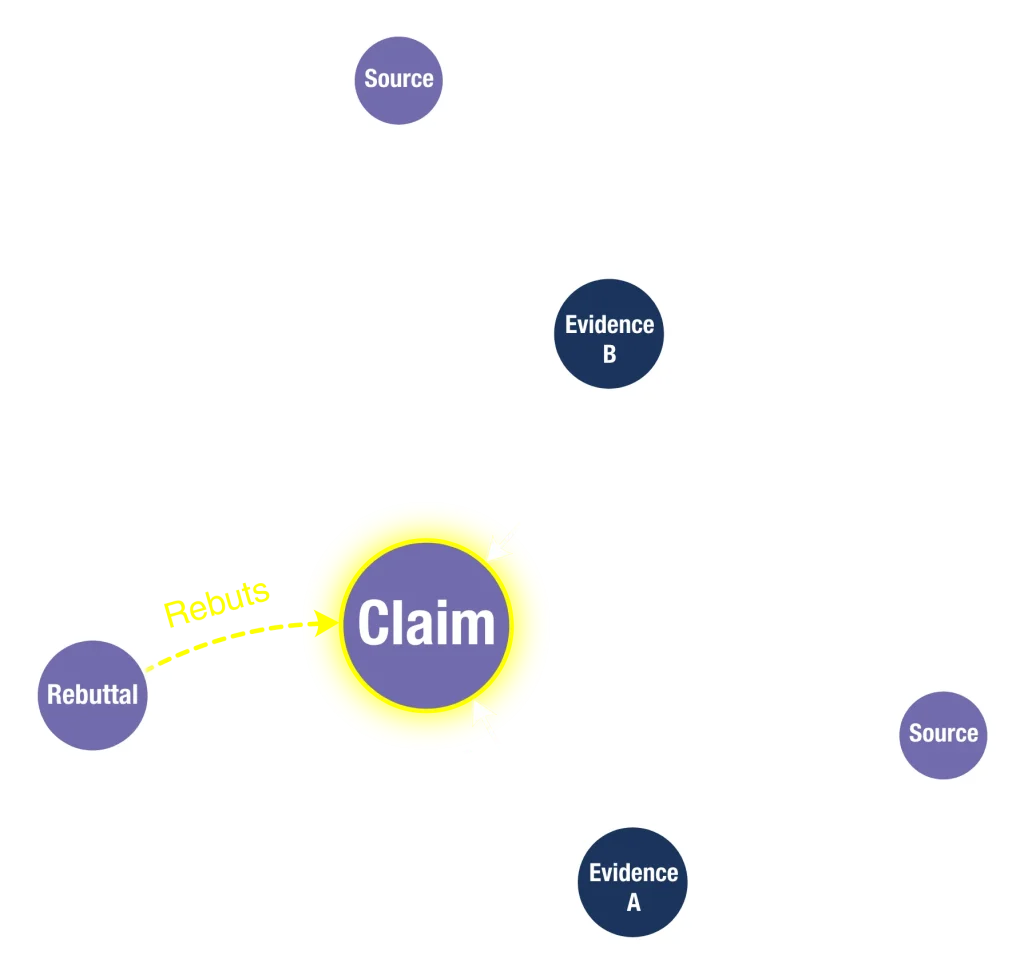
The entire decision-making process involving humans and AI is modeled as a “directed graph. It visualizes the relationship between claims, evidence, data, and counter-evidence, and prevents the process from becoming a black box.
Justification Mathematical evaluation
Quantifies data quality, causal consistency, ethics, and accountability with a proprietary algorithm.
Identification of areas for improvementand natural language presentation
The system automatically detects vulnerabilities such as “lack of sources” and “logical leaps,” and provides feedback in natural language using a generative AI. The system prompts actions to improve the quality of decisions.
 Human + AI Comprehensive
Assessment
While traditional XAI (explainable AI) only explains the model by itself, DDIM™ evaluates the validity of the entire process, up to the final human-intervened decision.
Technology
proprietary technology
Prove the ‘legitimacy’ of your decisions with mathematics, not
sensory
unique architecture
Structured Concepts of Decision Making
Decision-making is viewed as a graph structure (network) with “arguments” at the top. By visualizing the logical framework rather than numerical calculations, we identify “omissions” and “gaps” in the discussion.
Evaluation Process
It is executed in a series of systematized steps, from organizing and structuring information, to multifaceted quality assessment, to making integrated decisions, and to presenting areas for improvement.
Business Impact
Effects of introduction

Genetic and static decisions
- Process
- Relies on individual experience and tacit knowledge, and once decisions are made, they tend to be formalized, although they are recorded in meeting minutes.
- Challenges
- When new information becomes available, there is no mechanism for immediate review of decisions, and discrepancies with the situation are likely to occur. Responsibilities also tend to be unclear.

Structured and dynamically updated
The decision-making structure is visualized ‧
managed and changes are triggered and
assessments are automatically updated.
- Adding new evidence:
- Finding Reinforcing Data
- Occurrence of rebuttal evidence:
- Facts that overturn a premise
- Change in decision conditions:
- Change in law ‧Change in target
Maintains a state of decision-making that is always based on the most up-to-date information and most inte grity.
Use Case
Case Studies
Ensure
quality of decision making in all areas
Management and Business Decisions
- Proven objectivity in due diligence in management and investment decision-making M&A and new business entry.
- Records of the decision-making process as evidence of the fulfillment of the audit “duty of care” of the board of directors and board of directors.
Public and Government
- Transparency of administrative and policy decision-making processes and accountability to citizens.
- Governance and AuditingIndependent verification of the logical validity of public funding and regulatory formulation.
Medical/Healthcare
- Diagnostic Assistance Accountability AImplifies informed consent for patients by integrating diagnostic assistance systems and physician judgment.
- Visualization of the balance between treatment decision-making process guideline compliance and individual circumstances to reduce the risk of medical litigation.
AI Ethics and Controls
- Validity evaluation of AI judgments AI inferences, which tend to be black-boxed, are given a rationale by external knowledge graphs.
- Quantitative scores for ethical and fairness check bias (bi) and ethical deviation (ui) are used to make release decisions.
Value
value provided (by product, service, etc.)
Proof of decision quality and accountability
- Quantitatively visualize the accountability of decision-making (Accountability) and build trust with stakeholders.
- Reduce compliance risk by improving the sophistication and efficiency of audit and review responses.
- Break away from and standardize decision-making processes that rely solely on geriatric “intuition and experience.
Transparent and trustworthy Fair decision-making infrastructure
- Avoid black boxing and build a reliable social system in which AI and humans cooperate with each other.
- Provide a decision-making infrastructure that is transparent and can be verified and reproduced by anyone.
- Promoting the use of AI with guaranteed ethical relevance.
Third-party evaluation Core Methods
- An exclusive scientific validation framework that supports its authority as a third-party evaluation organization.
- Establish objective and actuarial evaluation criteria for second opinion services.
- Core technologies that ensure the quality of the digital advisory strategy.