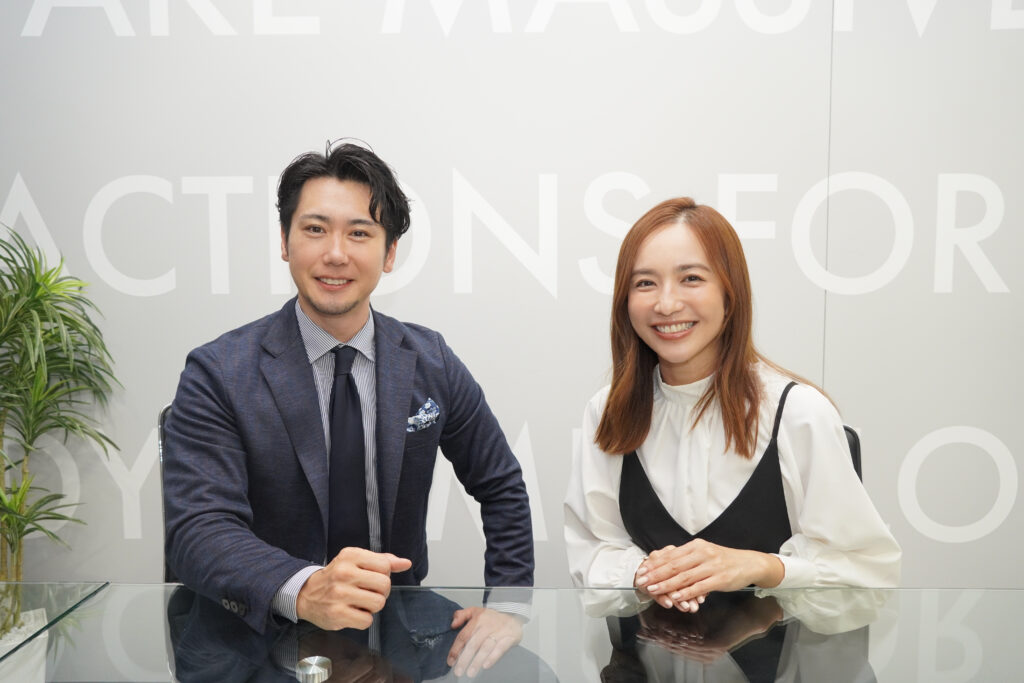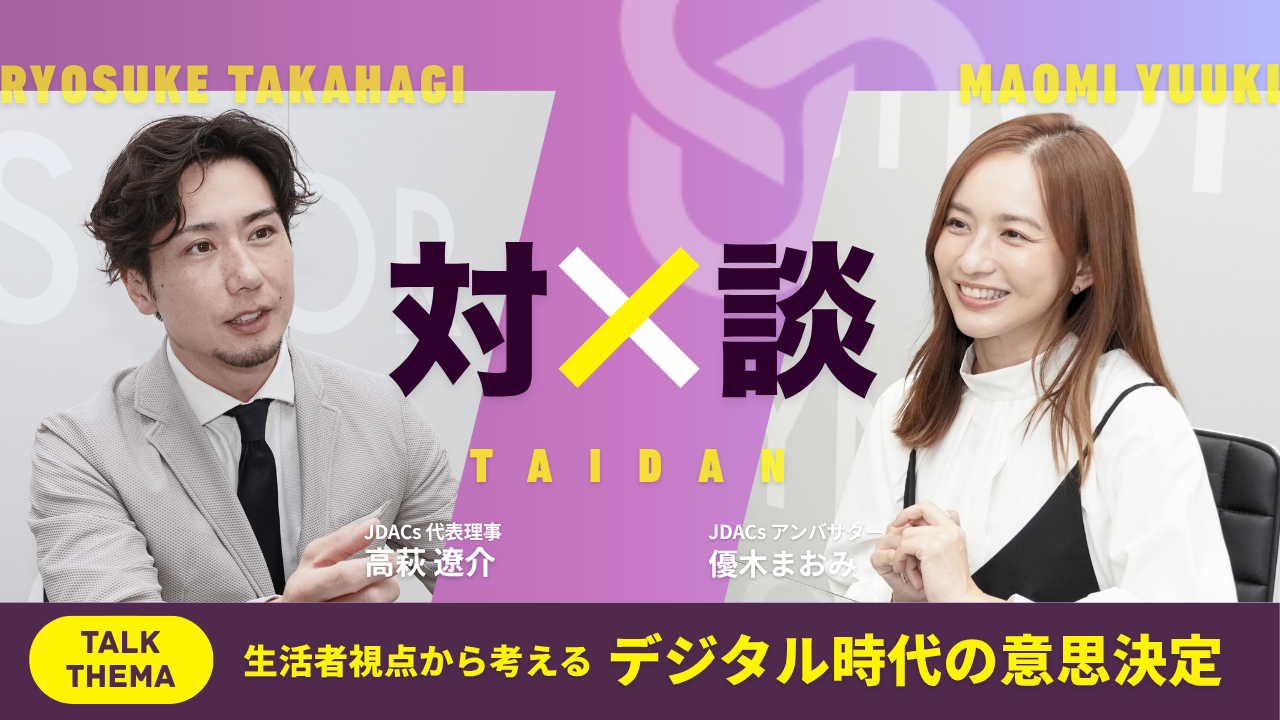
Conversation between Ryosuke Takahagi, Representative Director, and Maomi Yuuki, Ambassador
■First Things First
Digital technology and AI are no longer just for companies and governments.
It permeates all aspects of our daily lives, child-rearing, education, and work styles.
In such a situation, what should sei-katsu-sha choose and how should they make decisions?
JDACs Representative Director Ryosuke Takahagi and Ambassador Maomi Yuuki engaged in a dialogue on “Digital Decision Making in Our Lives.
■Distance between digital and daily life
Mr. Takahagi
Mr. Yuuki, you moved to Malaysia in 2023 and are living in two locations, Japan and overseas.
What is the presence of digital technology in its life?
Ms. Yuuki
It is indispensable.
Most of my work meetings are online, and I use digital tools on a daily basis in my children’s education.
Communication with family and friends in Japan is also possible in large part because of technology.
However, while it has become more convenient, there are more and more situations where I wonder if this is really the right thing to do.
Mr. Takahagi
What are the specific situations?
Ms. Yuuki
For example, to what extent should we allow our children to use tablets?
How to teach them how to interact with social networking sites?
Because there is no right answer to these questions, there are many things to worry about as a parent.

■ Expert knowledge and sei-katsu-sha perceptions
Mr. Takahagi
JDACs is mainly targeting corporations, governments, and educational institutions, and that is exactly why we asked Ms. Yuuki to be our ambassador.
Expert discussions tend to be full of jargon and abstract concepts.
But it is the people who live their daily lives who are most closely affected by digital technology.
We believe that without valuing this perspective, true social significance cannot be created.
Ms. Yuuki
Thank you. I am not an expert myself, but that is why I feel the way I do.
The topic of digital and AI often sounds so difficult.
We hear words like “DX” and “AI utilization,” but it is difficult to understand how they relate to our own lives.
But in reality, even with a single smartphone app, we are receiving digital benefits on a daily basis, and at the same time, we are exposed to risks.
Mr. Takahagi
You are right. And the risks are often hard to see.
There are many aspects of how personal information is handled, what criteria the algorithm uses to display recommendations, and many other things that are difficult to notice just by using the site normally.
■From the Field of Childcare and Education
Ms. Yuuki
When raising children, the relationship between education and technology is a theme that is really close to home.
For example, tablets are being handed out at schools and digital teaching materials are being introduced. That in itself is a good thing.
However, parents are rarely told why the materials were chosen or how the children’s data is managed.
Mr. Takahagi
Digitization of educational institutions is one of the key themes for JDACs, and while the market for EdTech (educational technology) is rapidly expanding, there are still many challenges when it comes to whether the selection and implementation process has been adequately tested.
In many cases, schools are forced to make decisions with limited professional human resources, and as a result, they accept vendor proposals as is.
Ms. Yuuki
As parents, we want our children to receive a good education, but we are also concerned about whether this is really the right thing to do.
I want to talk to someone about it, but I don’t know where to ask.
Mr. Takahagi
That situation of “no one to consult” is precisely what we are aware of as a problem.
While a company can seek outside consultants, for the average consumer or an educational institution with a limited budget, the opportunity to obtain advice from a neutral standpoint is very limited.
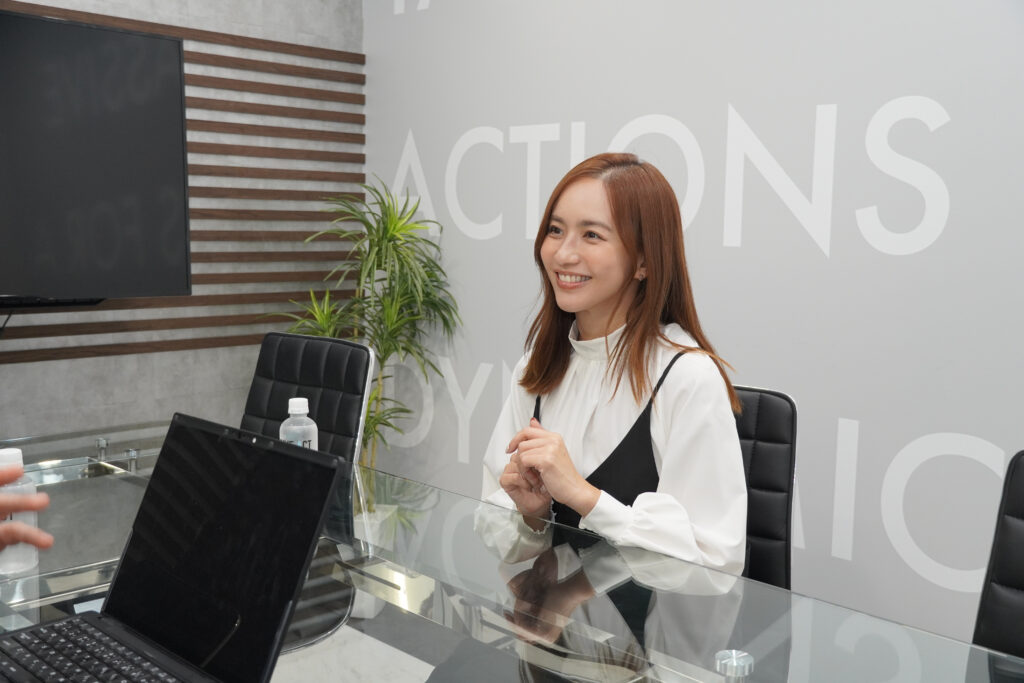
Role as a “bridge
Ms. Yuuki
When I thought about what I could do as an ambassador for JDACs, I knew that I would have to be a “bridge-builder.
People in my position translate the knowledge possessed by experts into “sei-katsu-sha” (consumers’ language) and convey it to them. Conversely, the concerns and questions felt by consumers are conveyed to the experts. I think this two-way communication is important.
Mr. Takahagi
That is exactly what we wanted to ask Mr. Yuuki to do.
JDACs philosophy of “neutrality,” “verifiability,” and “social integrity” may sound a bit stiff as words. But at the root of it all is a simple desire to create a society in which each individual can make decisions with conviction based on honest and reliable information.
Ms. Yuuki
It also overlaps with the values I hold dear.
In this age of information overflow, it has become difficult to know “what to believe. Especially when it comes to the future of our children, we want to think carefully but positively.
■For the Society of the Future
Mr. Takahagi
Digital technology will continue to evolve.
The development of AI will change the way we live and work.
JDACs hopes to provide society with the right information and a reliable axis of judgment.
Ms. Yuuki
As a mother and a person of life, I am happy to be involved in this activity.
I would like to try to communicate difficult things in a way that makes people think, “I see, that’s how it is.
Mr. Takahagi
Please join us in working together.
We will build a better society through dialogue with consumers, not through closed discussions among experts alone. That is the goal of JDACs.
Ms. Yuuki
It’s nice to meet you, too.